Singapore On A Budget: How To Fill Days For Free
Singapore has a reputation for expense, and parts of it earn that reputation. The counterweight is a long list of genuinely free ground: parks, temples, waterfronts and eighteen free walking tours that run on a pay-what-you-want basis.
Short answer
Singapore on a budget works because the free layer is wide: the Botanic Gardens, the outdoor gardens at Gardens by the Bay, temples, hawker-centre tables and the nightly light shows all cost nothing. The paid traps are the conservatories (S$46), NHB museums (S$18 at the National Museum) and the Sentosa Express at S$4.
Singapore on a budget is less about sacrifice than about knowing which layer of the city you are standing in. The paid layer is real: the conservatories at Gardens by the Bay, the observation decks, the Mandai parks. The free layer is just as real and far larger than most itineraries admit, and it includes the walks. Eighteen free walking tours run in Singapore, listed on GuruWalk and freetour.com, every one of them pay what you want, and they thread through the same districts a visitor would otherwise pay to see from a bus.
The budget question, worked through day by day: what a free day actually looks like, what hawker centres cost to enter, how to move around without paying for transport you do not need, and where the honest answer is that Singapore is not cheap.
How Do You Do Singapore On A Budget?
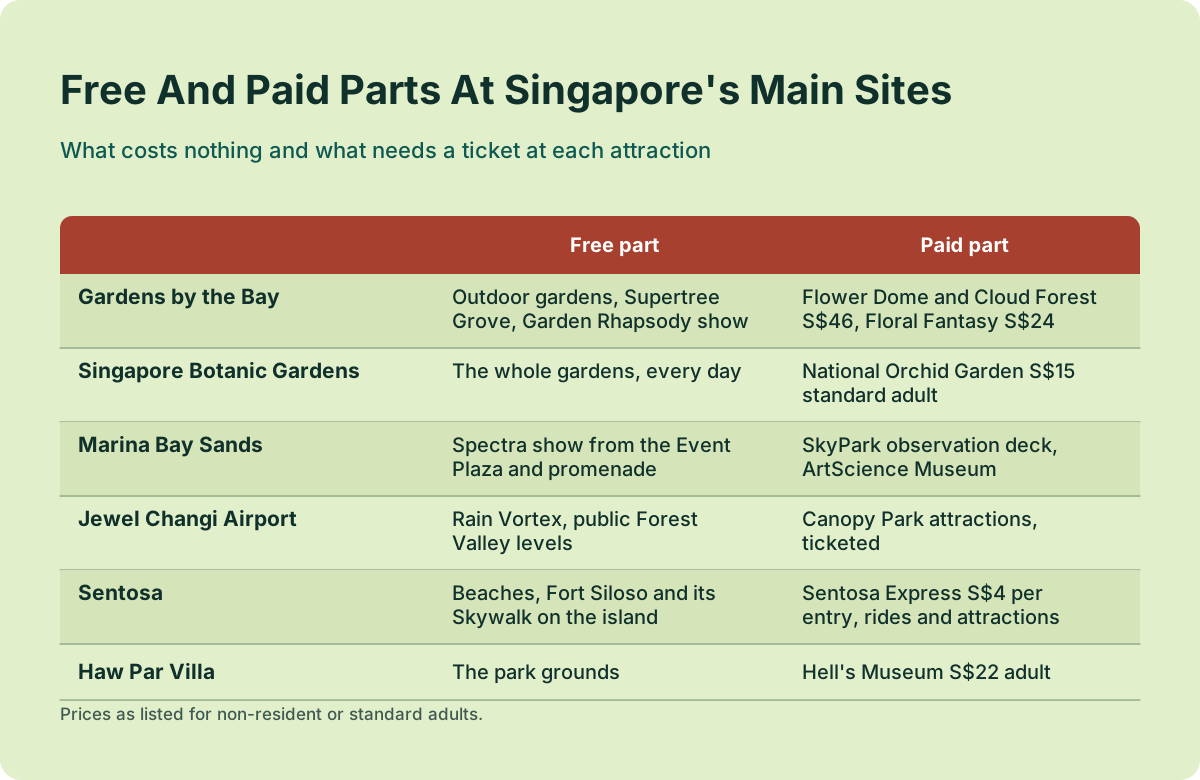
You do Singapore on a budget by building days around the free ground and paying only for the things you have deliberately chosen: the outdoor gardens, the Botanic Gardens, the temples, the riverside promenades and the hawker-centre tables all cost nothing, while the conservatories, the observation decks and the tourist-priced museums are separate, optional purchases. The discipline is one of separation. Every big Singapore attraction has a free part and a paid part sitting beside each other, and the budget traveller's job is to know which is which before arriving, not at the ticket counter.
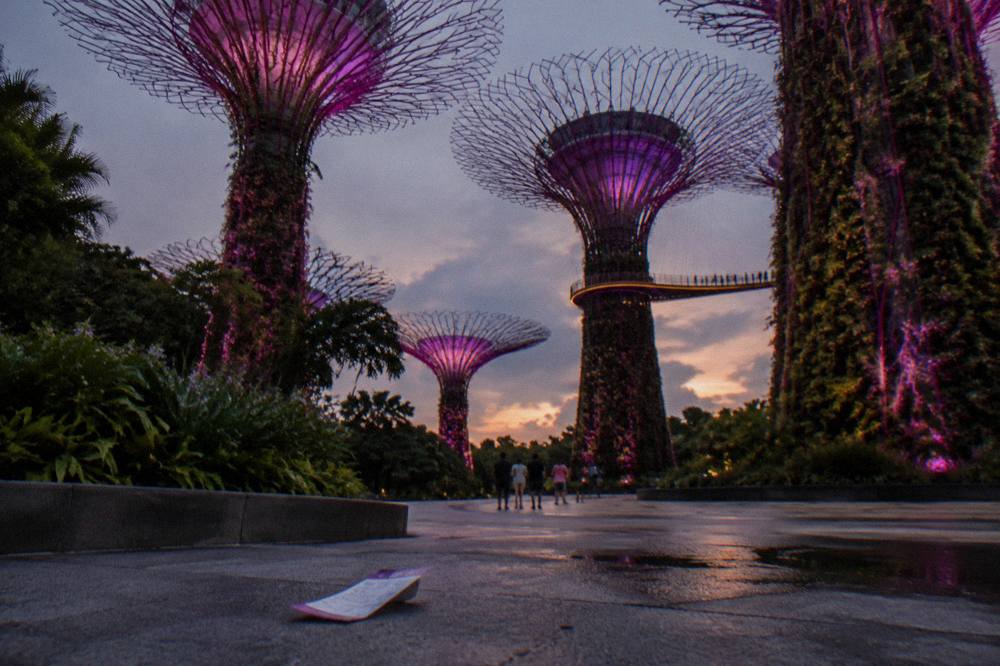
The clearest example is Gardens by the Bay. The outdoor gardens, the Supertree Grove at ground level and the Garden Rhapsody show, at 7.45pm and 8.45pm, are free; the Flower Dome and Cloud Forest cost S$46 for a non-resident adult, Floral Fantasy S$24, and the OCBC Skyway and Supertree Observatory S$14 each. A visitor can spend a full evening under the Supertrees and watch the show without any ticket. The monthly maintenance closures matter here too: Cloud Forest is closed on 26 October and 17 November 2026, Flower Dome on 16 November, the OCBC Skyway on 4 November and 9 December, and the Supertree Observatory on 5 November and 10 December, while the free outdoor gardens and the show are unaffected by these notices, according to the operator's opening hours page.
The same split repeats across the city. The Singapore Botanic Gardens, a UNESCO World Heritage Site, are free for everyone every day; the National Orchid Garden inside is the only paid zone, at S$15 for a standard adult. The Spectra light and water show at Marina Bay Sands is free to watch from the Event Plaza and the waterfront promenade, while the SkyPark observation deck above it is a separate paid ticket. At Jewel Changi Airport, the Rain Vortex and the public Forest Valley levels are free to look at and walk; the Canopy Park attractions above are ticketed.
The table below is the short version of the split, and it is the single most useful thing a budget traveller can hold in mind.
| Site | Free part | Paid part |
|---|---|---|
| Gardens by the Bay | Outdoor gardens, Supertree Grove at ground level, Garden Rhapsody show | Flower Dome and Cloud Forest S$46 non-resident adult, Floral Fantasy S$24, OCBC Skyway S$14, Supertree Observatory S$14 |
| Singapore Botanic Gardens | The whole gardens, every day | National Orchid Garden S$15 standard adult |
| Marina Bay Sands | Spectra show from the Event Plaza and promenade, walking through The Shoppes | SkyPark observation deck, ArtScience Museum |
| Jewel Changi Airport | Rain Vortex, public Forest Valley levels | Canopy Park attractions, ticketed |
| Sentosa | Beaches, Fort Siloso and its Skywalk once on the island | Sentosa Express S$4 per entry, all rides and attractions |
| Haw Par Villa | The park grounds | Hell's Museum S$22 adult |
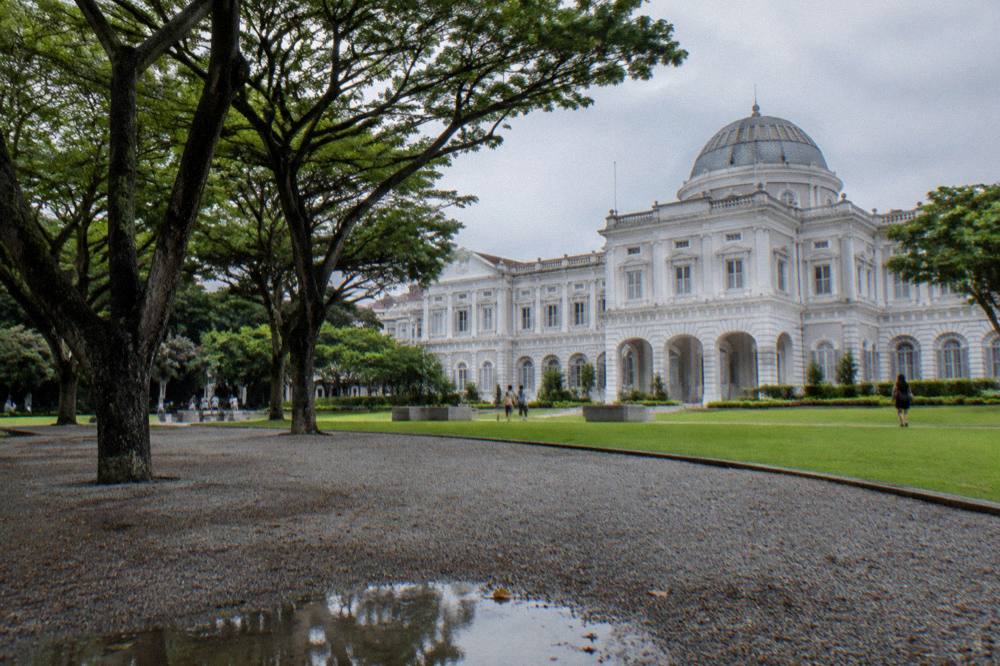
One warning: it is the trap that catches the most people. The National Heritage Board museums, the National Museum of Singapore included, are free only for Singapore citizens and permanent residents, who scan an NRIC at the door. Tourists pay: S$18 at the National Museum, S$12 at the Peranakan Museum, S$10 at the Malay Heritage Centre, S$10 at the Indian Heritage Centre and S$9 at Changi Chapel and Museum. A visitor who read "Singapore's museums are free" and planned a museum day around it will be paying at every door.
The free layer also has a human version. The walks listed on Free Things To Do In Singapore cover this in detail, but the shape is simple: you reserve a free spot, you walk, and you pay the guide what you think the walk was worth at the end. The amount is the walker's choice.
What Are The Best Free Days In Singapore?
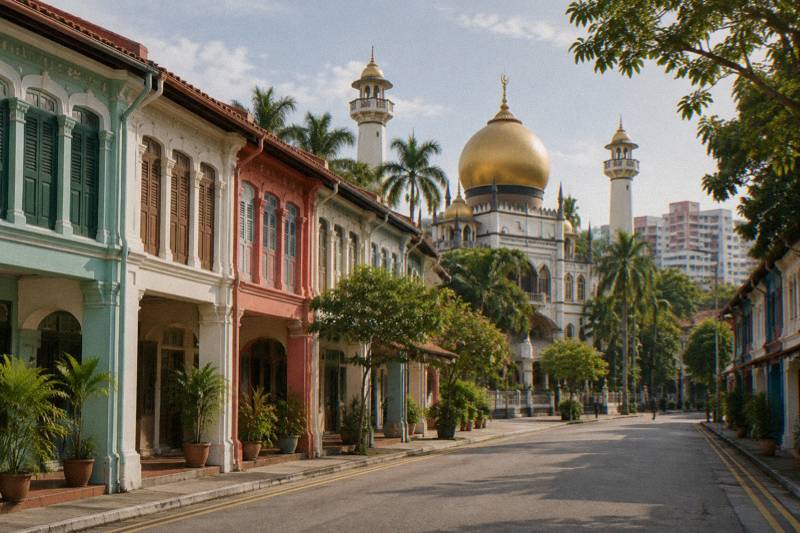
The best free days are the ones built on districts rather than attractions: a Civic District and Marina Bay day, a Chinatown day, a Little India or Kampong Glam day, a Botanic Gardens day and an evening at Gardens by the Bay for the Garden Rhapsody show, each of which costs nothing at the door. Districts are where the free city lives. The neighbourhoods themselves, Chinatown, Kampong Glam with Haji Lane and Arab Street, Little India around Serangoon Road and Tekka Centre, Joo Chiat and Katong, and Tiong Bahru, are all free to walk, and the temples inside them carry only dress rules, not tickets.
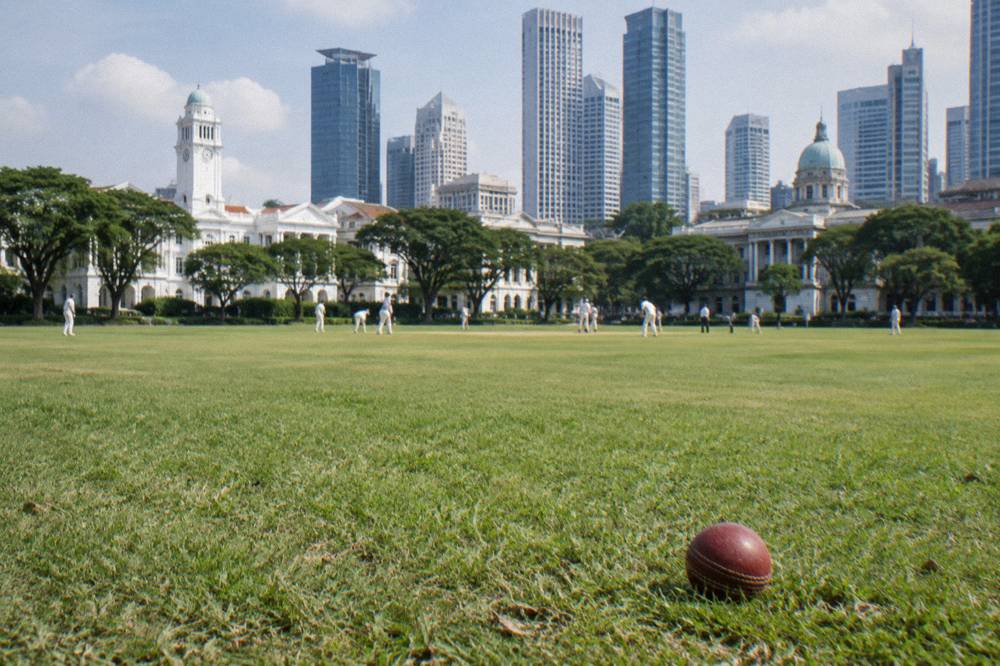
A city-centre day is the natural first one. The Civic District, the Singapore River promenade from Clarke Quay to Boat Quay, Merlion Park, the Esplanade waterfront and the Helix Bridge are all free public ground, and the Colonial To Contemporary walk by Chew Keng Kiat on freetour.com, rated 9.5 out of 10 across 26 freetour.com reviews, is an easy walk from the Civic District to Marina Bay that costs nothing up front and meets at City Hall MRT Station.
For a longer historical version of the same ground, 700 Years Of History by the guide Paul runs 3 hours and is rated 5 out of 5 across 486 English-language GuruWalk reviews, the largest review pool on the GuruWalk side of the roster after the hero walk. It meets near the Civic District and its page lists Fort Canning Park among its stops, and Fort Canning Park itself is free and open 24 hours, so the walk and the park can share a day.
Raffles Place is another anchor for a free day. The Lion City Adventure by Avi on freetour.com, rated 7.7 out of 10 across 40 freetour.com reviews, starts at Raffles Place Park, and the 2 Hours 30, City Free Walk by Monster Day Tours on GuruWalk, rated 4.9 out of 5 across 263 English-language GuruWalk reviews, meets at Raffles Place MRT Station and its page lists the River Merchants sculptures, Cavenagh Bridge and the National Gallery Singapore among its stops. Either one can carry the morning of a waterfront day that ends, free, at the Spectra show in the evening.
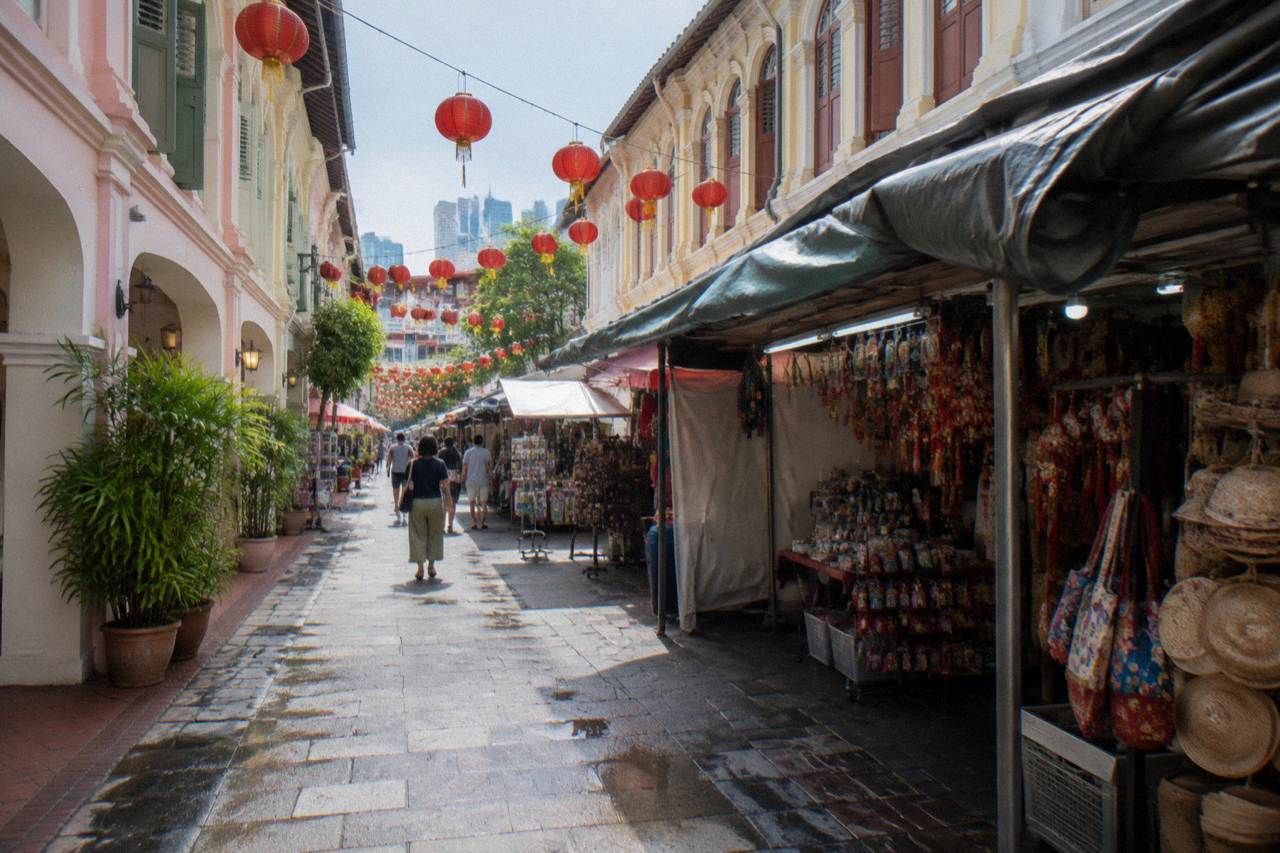
Chinatown is the densest free day of all, and most of the roster's walks start there. The Buddha Tooth Relic Temple and Museum is free to enter with shoulders and knees covered, Thian Hock Keng on Telok Ayer Street is free, Sri Mariamman asks for shoes off and modest dress, and the Chinatown street market and Pagoda Street are free to walk and browse. The 3 Hours, Chinatown To Tekka Market walk by Offbeat, the hero of the roster at 4.76 out of 5 across 1,010 English-language GuruWalk reviews, lists Chinatown Complex, Little India and Tekka Market as stops, which is two free districts and a hawker and wet market in one pay-what-you-want walk; See this free tour to read its own page.
Little India carries its own seasonal bonus. The Deepavali light-up on Serangoon Road runs nightly from 7pm to midnight, with the Festival Village on Campbell Lane from 10 October to 8 November 2026, and Deepavali itself falls on 8 November; the light-up dates are reported by a single source, so treat the window as approximate rather than pinned. Walking the light-up costs nothing. The Sultan Mosque in Kampong Glam is free for non-Muslim walk-in visits Saturday to Thursday, 10am to 12pm and 2pm to 4pm, closed on Fridays, with robes lent to visitors who are not properly attired.
If the plan is to fill several days this way, the site's guide to free walking tours in Singapore lays out all eighteen walks by district, and free things to do in Singapore at night covers the evening layer, from Garden Rhapsody to Spectra.
For a first day that needs a single decision rather than a menu, these three walks cover the city-centre ground, the Chinatown ground and the three-quarters sweep respectively, all pay what you want.
What Do Hawker Centres Cost To Enter?
Hawker centres cost nothing to enter and nothing to sit in: entering and sitting is free at Maxwell Food Centre, Lau Pa Sat, Newton, Chinatown Complex and Old Airport Road, and every other hawker centre in the city, while the food itself is paid, bought per dish at the stalls. That is the whole economics of a hawker-centre day. The building is public ground, the tables are unreserved, and the only money that changes hands is for whatever a diner chooses to carry to the table.
This matters for a budget itinerary because a hawker centre is also the cheapest sheltered place to sit in the city. A visitor can plan a Chinatown day around Chinatown Complex, or a Little India day around Tekka Centre, which is both a hawker and a wet market, and treat the centre as the free base with food as the only line item. The site's Singapore hawker centres guide goes centre by centre through the details.
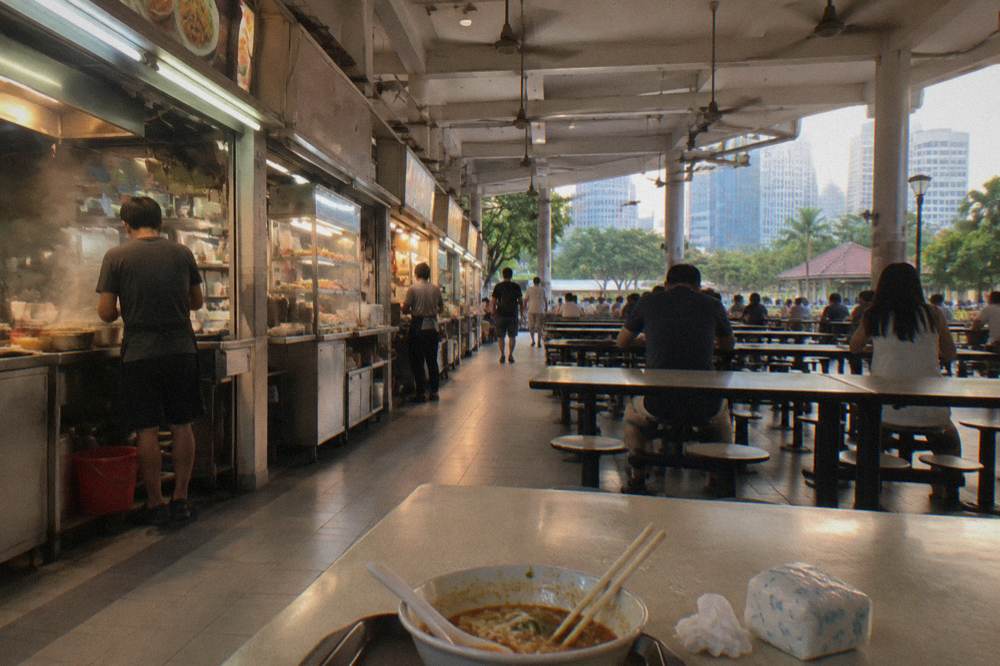
Two walks in the roster are food walks, and both need the same careful sentence. The 2 Hours 45, Hawker Hop by Angel, rated 4.98 out of 5 across 43 English-language GuruWalk reviews, is a food walk through Chinatown hawker centres that is pay what you want, with the food bought separately, in cash, at the stalls. The 3 Hours, Heritage And Food Trail by Emily C Yin, rated 4.88 out of 5 across 8 English-language GuruWalk reviews, is the same arrangement: the walk itself is pay what you want, the food is a separate cost. Neither is a free food tour, and no budget should count the eating as covered by the walking.
| Hawker centre | Entering and sitting | Food |
|---|---|---|
| Maxwell Food Centre | Free | Paid per dish at the stalls |
| Lau Pa Sat | Free | Paid per dish at the stalls |
| Newton | Free | Paid per dish at the stalls |
| Chinatown Complex | Free | Paid per dish at the stalls |
| Old Airport Road | Free | Paid per dish at the stalls |
| Tekka Centre | Free | Paid per dish at the stalls |
The other walks in the roster are not food walks, and nothing on them should be counted as a meal. Budget the walking and the eating as two separate lines, and the hawker layer stays honest: free to occupy, paid to eat.
How Do You Move Around Cheaply?
The cheapest way to move around Singapore is walking, because the walkable districts are free ground; public transport is never free for visitors, with nothing on the MRT or bus network free beyond children under 7 or under 0.9m on basic fares, so the budget question is where walking replaces a fare rather than how to avoid one. There is no free-transport trick in Singapore. The honest answer is that the MRT and buses are paid, and the way to spend less on them is to plan days that cluster inside one district rather than criss-crossing the island.
The SG Arrival Card is the one genuinely free piece of travel admin: submitting it is free for most travellers, within three days before arrival. Beyond that, the fare layer is straightforward. On Sentosa, walking in over the Boardwalk from VivoCity costs nothing, while the Sentosa Express monorail is S$4 per entry and every ride and attraction on the island is paid; the beaches and Fort Siloso with its Skywalk are free once on the island, so the boardwalk is the budget route. To Pulau Ubin, the trails and the Chek Jawa boardwalks are free to walk, but the island needs a paid bumboat from Changi Point Ferry Terminal, about S$4 each way, plus S$2 for a bicycle. A section of the Chek Jawa boardwalk is reported closed for maintenance from 15 September 2026 to 30 April 2027, with the island's other areas open 7am to 7pm.
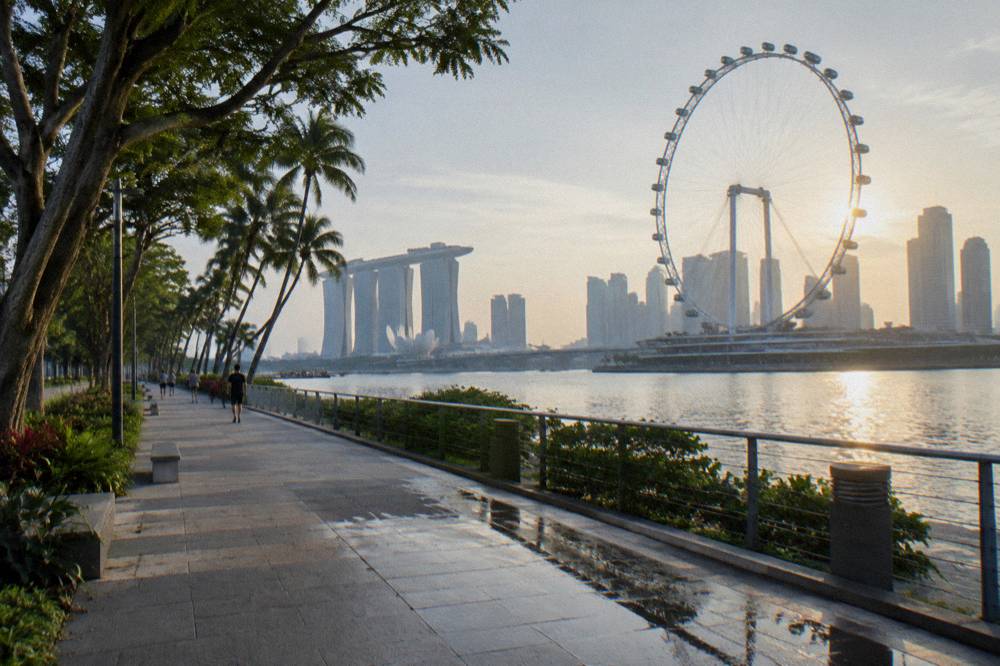
The one place where transport and sightseeing genuinely merge is the pay-what-you-want walk. A walk that meets at City Hall MRT Station, like Colonial To Contemporary, does the work of a transfer and a tour in the same 2 hours 30 minutes, and costs nothing beyond what the walker chooses to hand the guide at the end.
| Way of moving | Cost for a visitor |
|---|---|
| Walking the districts and promenades | Free |
| MRT and bus | Paid; nothing free for visitors, children under 7 or under 0.9m ride free on basic fares |
| Sentosa on foot via the Boardwalk from VivoCity | Free |
| Sentosa Express monorail | S$4 per entry |
| Pulau Ubin bumboat from Changi Point Ferry Terminal | About S$4 each way, S$2 for a bicycle |
| Mount Faber cable car | Paid |
Is Singapore Cheap For Visitors?
Singapore is not cheap for visitors, but it is unusually generous at its edges: the parks, gardens, temples, waterfronts and light shows are free, while the museums charge tourists, the big paid attractions start at S$14 and reach S$46, and the Sentosa layer adds its own fares. The fair summary is a city where a disciplined visitor can spend almost nothing for three or four days, and an undisciplined one can spend heavily without trying. The difference is almost entirely the free-versus-paid split in the first table.
The museum line deserves its own numbers, because it is the line most often misplanned. Tourist adult prices at the National Heritage Board's sites run S$18 at the National Museum of Singapore, with children aged 6 and under free, S$12 at the Peranakan Museum, S$10 at the Malay Heritage Centre, S$10 at the Indian Heritage Centre and S$9 at Changi Chapel and Museum. Citizens and permanent residents enter the permanent galleries free with an NRIC scan. For the Asian Civilisations Museum, Singapore Art Museum, Reflections at Bukit Chandu, Memories at Old Ford Factory and the Chinatown Heritage Centre, check the operator for a tourist price. At National Gallery Singapore, citizens and PRs get free general admission and tourists pay; the UOB Southeast Asia Gallery inside is temporarily closed until late 2027, with the rest of the Gallery open.
The free layer, by contrast, holds up across a whole trip. The parks and trails, Fort Canning Park, East Coast Park, the Southern Ridges with Henderson Waves, the HSBC TreeTop Walk at MacRitchie, Bukit Timah Nature Reserve, Jurong Lake Gardens, Pasir Ris Park, Bishan-Ang Mo Kio Park and the Marina Barrage rooftop green, are all free, per the National Parks Board's own site pages. Sungei Buloh Wetland Reserve is free admission, with Platform 1 closed for upgrading until 23 October 2026. The Raffles Hotel Long Bar is open to non-guest walk-ins, with drinks paid, so even the famous stops have a free way to stand in them.
So the honest answer: Singapore on a budget is not the same as Singapore being cheap. It is a city where the free layer is wide enough to fill every day, the walking tours that hold it together cost nothing up front, and the paid layer is a set of clear, avoidable price tags rather than a wall. Plan around the split and the budget holds; ignore it and the museums alone will prove the reputation.
Before the closing questions, three more pay-what-you-want walks that fill the Chinatown side of a budget plan, all on GuruWalk, all meeting inside or beside the district they explain.
Common Questions About Singapore On A Budget
How Do You Do Singapore On A Budget?
You build days around the free layer: the outdoor gardens at Gardens by the Bay, the Botanic Gardens, the temples, the riverside promenades and the hawker-centre tables, then pay only for the optional purchases like the conservatories at S$46 non-resident adult or the NHB museums at S$18 to S$9 for tourists.
What Are The Best Free Days In Singapore?
A Civic District and Marina Bay day, a Chinatown day, a Little India or Kampong Glam day, a Botanic Gardens day and an evening at the Supertree Grove for the 7.45pm and 8.45pm Garden Rhapsody show. Every one of these costs nothing at the door, and pay-what-you-want walks cover the same districts.
What Do Hawker Centres Cost To Enter?
Nothing. Entering and sitting is free at every hawker centre, including Maxwell Food Centre, Lau Pa Sat, Newton, Chinatown Complex and Old Airport Road. The food is paid, bought per dish at the stalls, and the two food walks in the roster are pay what you want with the food bought separately, in cash.
How Do You Move Around Cheaply?
Walk. Nothing on the MRT or bus network is free for visitors, beyond children under 7 or under 0.9m on basic fares, so the saving comes from clustering days inside one district. The Sentosa Boardwalk is free to walk in on, against S$4 for the Sentosa Express, and the Pulau Ubin bumboat runs about S$4 each way.
Is Singapore Cheap For Visitors?
No, but the free layer is wide. Parks, gardens, temples, waterfronts and the nightly light shows cost nothing, while tourists pay at the NHB museums, from S$18 at the National Museum of Singapore down to S$9 at Changi Chapel and Museum, and the big paid attractions run from S$14 to S$46.